Can AI Make Hiring Less Biased?
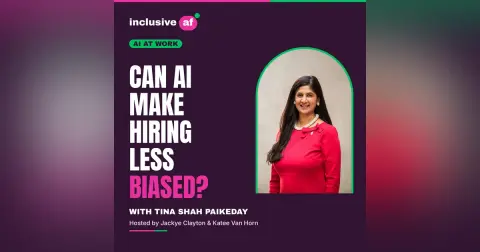
General AI can be more biased than humans. Here is what HR leaders should check before they buy a hiring tool.


Key Takeaways
- General purpose AI draws on unstructured data and can actually produce more bias than humans, while AI built specifically for recruiting can widen candidate slates and raise quality.
- Tina Shah Paikeday emphasizes that HR leaders must always ask vendors how their hiring tools were built, what data went into them, and how they were tested for bias.
- Only about 5% of CHROs currently demonstrate strong AI fluency, leaving a massive gap in leadership understanding as automated hiring tools become more prevalent.
- Hiring teams now face the unique challenge of using AI simply to sort through the massive flood of resumes and applications also generated by AI.
- With automated hiring laws moving from soft guidance to strict enforcement in places like New York City, California, and the EU, HR teams need tools with built-in guardrails.
General purpose AI can be more biased than humans. AI built for hiring can widen the candidate slate and raise quality at the same time. Tina Shah Paikeday, Senior Advisor for Responsible AI at Findem, has tested both, and she explains what HR leaders should check before they buy.
Jackye Clayton and Katee Van Horn get into how to vet an AI hiring tool, why only about 5% of CHROs have real AI fluency, what new laws mean for anyone using automated hiring decisions, and how recruiters move from order taker to consultant.
Key Takeaways
General purpose AI draws on vast, unstructured data, and in Tina's testing it produced more bias than humans.
AI built specifically for recruiting can widen candidate slates and raise quality at the same time.
What goes into the data and the algorithm decides what comes out. Ask every vendor how theirs was built.
Hiring teams now need AI to sort through the flood of AI written applications.
Critical thinking and judgment are gaining value while tool specific skills lose it faster.
Of roughly 7,000 US CHROs Tina reviewed, about 5% showed strong AI fluency.
AI should make the recruiter role more strategic, not just faster.
The person you need may already work for you. Check inside before you post the job.
What you put into an AI tool can come back to you. Use tools with guardrails built for HR.
Hiring laws are moving from guidance to enforcement in New York City, California and the EU.
Timestamps
00:00 – Why general AI can be more biased than humans
03:36 – How AI can reduce bias in hiring
05:00 – How to vet an AI hiring tool
06:52 – The biggest hiring challenge: AI to sort through AI
12:17 – Only 5% of CHROs have AI fluency
14:33 – From order taker to consultant
20:27 – The scariest part: no guardrails
22:24 – Are your AI prompts protected?
25:54 – AI hiring laws: from soft law to hard law
27:27 – AI as a bias interrupter
Keywords
AI in hiring, hiring bias, responsible AI, recruiting technology, talent acquisition, AI regulation, CHRO, AI fluency, skills based hiring, HR technology
Before your next AI vendor demo, ask two questions: was this built for hiring, and how did you test it for bias?
Remastered from our original conversation with Tina Shah Paikeday, former partner and global practice head at Russell Reynolds.
Subscribe and join the inclusive conversation! Don't miss an episode of the Inclusive AF Podcast—stay connected and stay informed on diversity, equity, and inclusion topics. Follow us now!
Frequently Asked Questions
Can AI make hiring less biased?
Yes, but it depends entirely on the tool. General purpose AI often increases bias, whereas AI built specifically for recruiting and properly tested can widen candidate slates and improve hiring quality.
What should HR leaders ask AI vendors before buying?
HR leaders should ask whether the tool was specifically built for hiring, how the algorithm was trained, and how the vendor specifically tested the technology for bias.
How many CHROs have strong AI fluency?
Data reviewed by Tina Shah Paikeday shows that only about 5% of roughly 7,000 US CHROs exhibit strong AI fluency.
Where are AI hiring laws being enforced?
Automated employment decision laws are moving from soft guidance to strict enforcement in regions like New York City, California, and the European Union.